Featured Project
AWS LPU SSO - Identity Platform
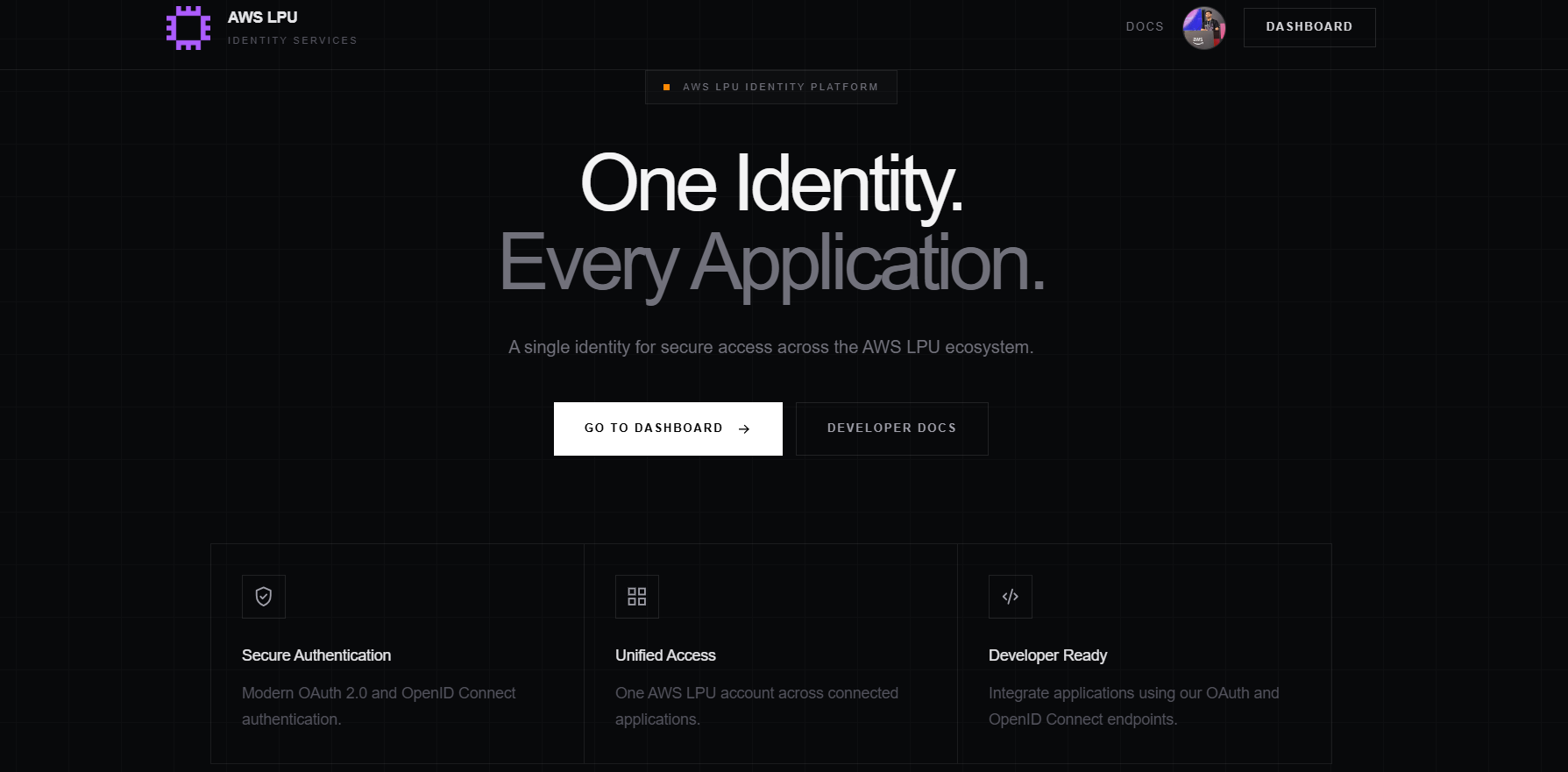
A centralized identity platform providing secure Single Sign-On across the AWS LPU ecosystem using OAuth 2.0 and OpenID Connect.
Technology
Overview
AWS LPU SSO is a centralized identity platform designed to provide a single authentication system across applications in the AWS LPU ecosystem. Instead of requiring users to create and manage separate accounts for every application, AWS LPU SSO provides one identity that can be used across connected services. The platform acts as an identity provider and implements OAuth 2.0 and OpenID Connect authentication flows. Applications can redirect users to AWS LPU SSO for authentication and receive authorization codes and identity information without directly handling user passwords. The system also provides account management, user profiles, role management, application authorization, and developer documentation for integrating new applications with the platform.
The Problem
As the AWS LPU ecosystem grows, different applications require authentication and user identity management. Without a centralized identity system, every application would need to independently implement authentication, maintain user accounts, manage passwords, and handle user profiles. This creates several problems: • Users need separate accounts and passwords for different applications. • Each application becomes responsible for securely handling authentication. • User identity and profile information becomes fragmented across services. • Applications cannot easily share authentication state. • Developers need to repeatedly build authentication systems for new projects. • Managing access and user roles becomes increasingly difficult as more applications are added. A centralized identity platform was needed to provide a secure and reusable authentication system for the entire ecosystem.
The Solution
I built AWS LPU SSO as a centralized identity provider that applications can integrate with using standard OAuth 2.0 and OpenID Connect protocols. Users authenticate directly with AWS LPU SSO instead of individual applications. Connected applications redirect users to the authorization endpoint and receive authorization codes after successful authentication. Applications can then exchange authorization codes for tokens and retrieve user identity information using protected endpoints. The platform supports the Authorization Code Flow with PKCE, state validation, and nonce handling to provide a more secure authentication flow. Users also have access to a centralized dashboard where they can manage their profile information, while administrators can access additional management capabilities based on their assigned role.
What It Does
Centralized Single Sign-On across connected AWS LPU applications
OAuth 2.0 Authorization Code Flow implementation
OpenID Connect support for standardized user identity
PKCE support for secure authorization flows
State and nonce validation for authentication security
Centralized user account and profile management
Immutable email identity managed through the authentication provider
Role-based access control for members and administrators
Application authorization with registered redirect URIs
Authorization code exchange for access and identity tokens
Protected user information endpoint
OpenID Connect discovery configuration
JWKS endpoint for token verification
Developer documentation for application integration
Test OAuth client for validating the complete authentication flow
Architecture
Application Layer
AWS LPU SSO is built with Next.js and TypeScript, handling both the user-facing application and server-side platform logic. This includes authentication flows, authorization endpoints, the account dashboard, application management, and developer documentation.
Identity & Authentication
Supabase Auth provides the underlying authentication infrastructure and manages user identity securely. The platform uses this layer to handle account authentication while keeping identity concerns separate from application-specific user data.
Profile & Application Data
Application-specific profile information is stored separately from authentication identity. This separation allows the platform to preserve secure authentication data while maintaining additional user information required across the AWS LPU ecosystem.
OAuth & OpenID Connect
Connected applications integrate with AWS LPU SSO through OAuth 2.0 and OpenID Connect flows. Applications redirect users to the authorization endpoint, receive authorization codes through registered callback URLs, exchange those codes for tokens, and retrieve authenticated user information.
Authorization & Security
The authorization flow includes PKCE, authorization code validation, state validation, nonce validation, registered redirect URI verification, and role-based access checks to help secure application integrations and authentication requests.
Engineering Challenges
Designing a secure OAuth 2.0 authorization flow while keeping the implementation suitable for applications in the AWS LPU ecosystem
Implementing Authorization Code Flow with PKCE to support secure public clients
Preventing unauthorized redirect URIs and validating registered application callbacks
Managing the separation between authentication identities and application profile data
Ensuring user roles are preserved correctly without allowing users to escalate their own permissions
Handling authentication redirects while preserving the original authorization request and return destination
Supporting existing authenticated users without interrupting the OAuth authorization flow
Implementing OpenID Connect endpoints including discovery configuration, user information, and JWKS support
Building a reusable developer experience so future AWS LPU applications can integrate without rebuilding authentication
Final Result
Outcome
AWS LPU SSO provides a reusable identity foundation for the AWS LPU ecosystem. New applications can integrate with a centralized authentication system instead of independently implementing user registration, login, password handling, and identity management. Users benefit from a single account and a consistent authentication experience across connected applications. The platform also establishes a scalable foundation for future services by using widely adopted standards such as OAuth 2.0 and OpenID Connect. This allows the AWS LPU ecosystem to grow while maintaining a centralized and secure approach to identity and authentication.